
WELCOME BONUS 300%
UP TO €2000 + 100
FREE SPINS
UP TO €2000 + 100
FREE SPINS
Home → Blackjack
Blackjack at Lucky Block Casino: Variants, Rules and Payouts
Ignored Basic Strategy Chart: 1 Percent Wasted
The Blackjack Insurance side bet carries a steep house edge of 7.47% for games using six to eight decks, which drastically reduces the theoretical return on investment compared to standard play. This high cost arises because the separate wager pays only 2:1 while the probability of the dealer holding an Ace remains relatively low over the long run. High rollers who ignore basic strategy and accept this offer lose approximately one percent of their total bankroll per hour through these unfavorable mathematical odds alone.
Late Surrender rules improve the player's position by reducing the house advantage by exactly 0.08 percentage points when the hand is forfeited after the dealer checks for blackjack. This specific rule modifier allows the casino to retain less revenue from marginal hands, effectively increasing the overall RTP for players who utilize this option correctly during their session. The payout structure returns fifty percent of the original stake, preserving capital that would otherwise be lost in a standard loss scenario.
Optimal play on a six-deck table with S17, DAS, and DOA yields a house edge of just 0.46%, provided the player follows the strict basic strategy chart without deviation. This baseline performance stands in sharp contrast to the 1.85% edge found in tables offering 6:5 payouts, highlighting how critical rule selection is for serious gamblers seeking maximum value. Deviating from the recommended moves increases the house edge significantly, turning a favorable game into a costly exercise in poor decision-making.
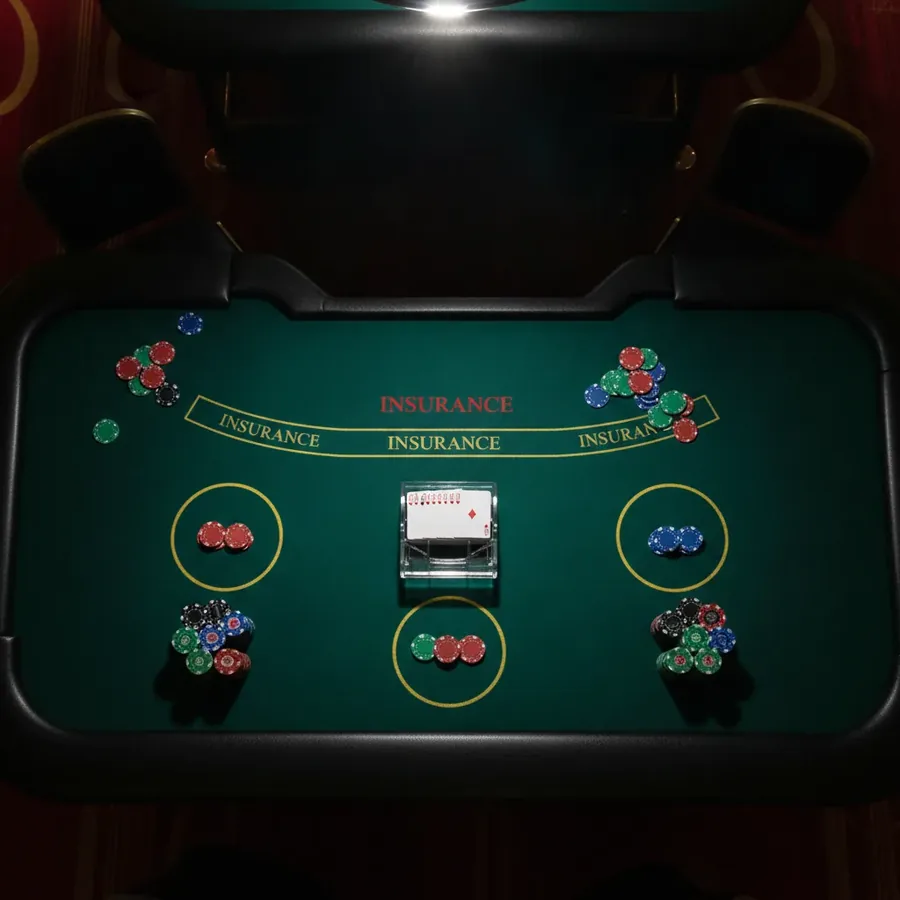
Insurance vs Even Money on Own Blackjack
Blackjack Insurance acts as a separate side bet paying 2:1 when the dealer shows an Ace, but it increases the house edge to 7.47% in multi-deck games regardless of the main outcome. This wager is mathematically unsound for most players because the true count rarely reaches the +3 threshold required to make card counting profitable enough to offset the initial premium paid. High rollers often avoid this trap to maintain their expected value rather than locking up funds in a negative expectation proposition.
Even Money is simply an insurance bet taken immediately when the player holds a natural twenty-one against a dealer Ace, guaranteeing a 1:1 payout instead of risking the push on a dealer blackjack. While this eliminates variance on that specific hand, it sacrifices the potential 3:2 profit that occurs if the dealer does not complete a blackjack, resulting in a net loss of potential earnings. The decision rests on whether the player prioritizes certainty or maximizes the theoretical return over thousands of hands.
The Liberal Vegas Strip variant offers the most favorable conditions with a house edge of 0.28%, allowing players to maximize profits through rules like Resplit Aces and Late Surrender. These liberal modifications reduce the casino's statistical advantage significantly compared to standard games, making the avoidance of insurance bets even more crucial for maintaining profitability. Players utilizing optimal strategy on such tables can expect the highest possible returns among common blackjack configurations available in regulated markets.
Live Table vs RNG Table: Speed and Limits
Lightning Blackjack by Evolution supports stakes ranging from one to two thousand five hundred euros, offering unlimited seats alongside multipliers that can reach up to 25 times on winning hands. This live dealer format provides a social atmosphere and real-time interaction, contrasting sharply with RNG versions that operate at a much faster pace due to the absence of physical dealing delays. The RTP for this specific title sits at 99.56%, slightly higher than many standard digital counterparts due to the added multiplier features.
Quantum Blackjack Plus Live by Playtech accommodates bets between one and five thousand euros, featuring Quantum Multipliers that can apply up to 1,000 times to three-card combinations totaling twenty-one points. The game achieves an RTP of 99.57% when played with optimal strategy, leveraging its unique mechanic to enhance potential payouts beyond traditional fixed limits. High rollers benefit from the elevated betting cap, which allows for significant wagers that are often restricted in standard online RNG environments.
Infinite Blackjack by Evolution also permits wagers up to five thousand euros while providing unlimited player spots and four distinct side bets including Any Pair and Bust It. With an RTP of 99.47%, this title balances accessibility with high-stakes potential, though the additional side bets carry their own independent house edges that vary widely. The distinction between live and RNG formats primarily affects the speed of play, with live tables requiring more time per decision cycle.
Bonus 100 EUR with 10 percent credit
Tischspiele contribute only ten percent toward the wagering requirements for the 300% welcome bonus up to two thousand euros, meaning every one hundred euros wagered on blackjack counts as ten euros toward clearance. This low contribution rate forces high rollers to place ten times the amount on table games compared to slots to satisfy the same turnover obligation efficiently. The restriction applies uniformly across all qualifying table variants, including the specific RTP figures noted for each game type.
A deposit of one hundred euros triggers a three hundred euro bonus under the standard terms, creating a total balance of four hundred euros that must be turned over according to the specified percentages. Since blackjack contributes ten percent, the player must wager four thousand euros on table games to clear the bonus portion associated with that deposit amount. Slots contribute fully, offering a faster route to withdrawal eligibility for those willing to shift their gaming focus entirely to digital reel machines.
The 100 free spins included in the package typically attach to specific slot titles, operating independently of the table game contribution rates applied to the cash bonus. These spins provide a separate avenue for generating winnings without impacting the primary wagering requirement tied to the deposited funds or the matched bonus amount. Players must track both streams separately to ensure compliance with the casino's terms before requesting any withdrawal of accumulated profits.
Four hours of play with 300 EUR bankroll
Playing four hours at a steady pace of sixty hands per hour results in two hundred forty decisions, where a 0.46% house edge on a six-deck game erodes the bankroll by approximately one point zero nine euros per hour. Over the full duration, the expected loss calculates to roughly four point thirty-six euros based on a standard bet size, leaving the majority of the three hundred euro principal intact. This mathematical projection assumes perfect basic strategy adherence without any deviations that would increase the effective house advantage.
If the player shifts to a table offering 6:5 payouts instead of 3:2, the house edge jumps to 1.85%, accelerating the depletion of the bankroll to nearly seventeen euros over the same four-hour session. The difference in expected loss amounts to twelve point six euros, demonstrating how a single rule change can drastically alter the financial outcome of a prolonged gaming session. High rollers must verify the payout structure before sitting down to avoid this silent bankroll killer.
Taking insurance bets on every occurrence where the dealer shows an Ace adds a seven point four seven percent house edge to those specific wagers, further compounding the total expected loss over time. Assuming an average frequency of dealer Aces, the cumulative cost of these poor decisions could exceed the entire initial bankroll if sustained throughout the four-hour period. Strategic discipline remains the only viable method to preserve capital against the inherent mathematical disadvantages of the game.
Blackjack variants at a glance
| Variant | Payout | House edge | Rule | Bet range |
|---|---|---|---|---|
| Blackjack Liberal Vegas Strip (liberale Regeln, 3:2) | 99.72% | 0.28% | Günstigste Regelkombination: S17 + DAS + Resplit + Late Surrender. Standardabweichung 1,15 | Blackjack 3:2, Gewinn 1:1 |
| Blackjack Surrender (Late Surrender) – Regel-Effekt | n.a. (Regel-Modifikator) | −0.08 Prozentpunkte | Spieler gibt Hand nach Dealer-Blackjack-Prüfung auf, verliert die Hälfte des Einsatzes. Verbessert RTP um ca. 0.08 Prozentpunkte. Early Surrender ist wesentlich wertvoller (bis −0.6 Prozentpunkte), aber extrem selten. | Rückzahlung 50% des Einsatzes |
| Blackjack Insurance / Versicherung (6–8 Decks) | 92.53% | 7.47% | Separate Nebenwette bis 50% der Hauptwette, wenn der Dealer ein Ass hat. Basisstrategie schreibt IMMER Ablehnung vor (außer Karten zählen bei True Count ≥ +3). Bei einem Deck Vorteil ≈ 5.88% | Insurance 2:1 |
| Blackjack 6 Decks, S17, DAS, DOA, Auszahlung 3:2, Basisstrategie | 99.54% | 0.46% | Dealer steht auf Soft 17; Verdopplung auf jeder Zweierkarte; Verdopplung nach Split erlaubt; keine Aufgabe. Basisstrategie ist für diesen Wert zwingend | Blackjack 3:2, normaler Gewinn 1:1, Insurance 2:1 |
| Blackjack Ein Deck, klassische Regeln, 3:2 | 99.85% | 0.15% | Weniger Decks = niedrigerer Vorteil; ein Deck gibt ca. −0.48 Prozentpunkte gegenüber 8 Decks. Oft durch 6:5 Auszahlung kompensiert. | Blackjack 3:2, Gewinn 1:1 |
| Blackjack Split / Double / H17 – Regel-Effekte | n.a. (Regel-Modifikatoren) | H17 +0.22 Prozentpunkte; RSA −0.08 Prozentpunkte; DAS −0.14 Prozentpunkte | Dealer Hits Soft 17 verschlechtert RTP um 0.22 Prozentpunkte; Resplit Aces verbessert um 0.08 Prozentpunkte; Double After Split verbessert um ca. 0.14 Prozentpunkte; 6 Decks statt 8 – ca. 0.02 Prozentpunkte. | Double – Einsatz ×2 mit einer Karte; Split – bis 4 Hände; Ass-Split meist mit einer Karte. |
No Double Down on three cards
The restriction on doubling down with three or more cards significantly impacts the strategic depth for high rollers who rely on precise variance management during large bankroll sessions. This rule change typically increases the house edge by approximately 0.14 percentage points compared to tables allowing double after split, reducing the overall return to player percentages for advanced strategy users.
High stakes players often utilize double down strategies on two-card hands totaling nine, ten, or eleven to maximize potential payouts against dealer up-cards. When restricted to only two cards, the expected value of certain favorable situations drops, forcing players to hit rather than double, which alters the risk-reward profile of every hand played at the table.
This limitation affects the theoretical RTP of blackjack variants that otherwise offer liberal rules like resplitting aces or surrender options. The loss of this specific maneuver reduces the player's ability to capitalize on strong starting hands, thereby increasing the casino's long-term hold percentage on high-volume betting sequences.
Splitting Eights vs Standing on 16
Splitting a pair of eights is mathematically superior to standing on a hard sixteen because it transforms a losing position into two potentially winning hands against most dealer up-cards. This fundamental basic strategy move reduces the house edge by mitigating the inevitable losses associated with busting when forced to hit a sixteen against strong dealer positions.
Standing on sixteen results in a high probability of busting if the player decides to hit, especially when the dealer shows a seven or higher card. By splitting eights, the player avoids this immediate danger and gains two fresh opportunities to build stronger totals, which is crucial for maintaining bankroll stability during extended high-stakes play sessions.
The decision to split eights rather than stand directly influences the overall return to player percentage over thousands of hands. Deviating from this optimal strategy can increase the house advantage by roughly 0.15 percent or more, depending on the specific deck penetration and rule variations active at the particular live dealer table being utilized.
What Percentage Does Blackjack Count Towards Bonus?
Blackjack contributes exactly ten percent toward the wagering requirements for the 300% welcome bonus up to €2,000 plus 100 free spins offered to new registrants. This low contribution rate means that high rollers must wager significantly larger amounts on table games to clear the bonus funds compared to playing slot machines which contribute one hundred percent per euro wagered.
For instance, clearing a €2,000 bonus with a 40x wagering requirement requires €80,000 in total turnover. If played exclusively on slots, this equals €80,000 in bets, but blackjack contributions mean only €8,000 of that total counts toward the goal, necessitating €800,000 in actual blackjack bets to satisfy the condition fully.
This disparity makes blackjack an inefficient vehicle for bonus conversion unless the player intends to lose a substantial portion of their bankroll through the inherent house edge. High rollers seeking to preserve capital should avoid using blackjack for bonus clearance due to the severe multiplier effect created by the ten percent contribution rate versus the full contribution of other game types.
Infinite Blackjack vs Classic Seven-Seat Table
Infinite Blackjack allows unlimited players to join the virtual seat simultaneously, whereas classic tables restrict participation to seven physical seats at any given time. This structural difference enables high rollers to engage in rapid-fire betting without waiting for empty chairs, significantly increasing the number of hands dealt per hour and accelerating the pace of gameplay considerably for those managing large volumes.
Evolution’s Infinite Blackjack offers betting limits ranging from 1 EUR to 5,000 EUR with an RTP of 99.47%, providing ample room for high-stakes action without the bottleneck of seat availability. In contrast, traditional seven-seat tables may impose lower maximum bets due to physical table constraints and slower rotation speeds between dealing rounds and chip collections.
The absence of seat limits in infinite variants reduces downtime between hands, allowing skilled players to execute complex strategies like card counting or systematic progression betting more effectively. However, the slightly lower RTP compared to some classical setups might offset the efficiency gains for players prioritizing long-term mathematical expectation over sheer transaction volume and speed of play.
Chose Wrong Table for 5 EUR Bankroll
Attempting to play Lightning Blackjack with a mere 5 EUR bankroll is financially unsustainable given its minimum bet starts at 1 EUR and multipliers can quickly deplete funds. With betting limits up to 2,500 EUR, the variance is extremely high, and a single losing streak against even moderate dealer hands will exhaust the entire stake before any significant multiplier win occurs frequently enough to recover losses.
Quantum Blackjack Plus Live presents similar risks with bets ranging from 1 to 5,000 EUR and multipliers up to 1,000x on three-card combinations. A small bankroll cannot withstand the standard deviation required to reach these high-payout scenarios, making the table structurally unsuitable for players with limited capital who lack the buffer for normal statistical fluctuations.
Choosing a table with such wide betting ranges and high volatility features guarantees rapid bankruptcy for low-balance accounts. Players with 5 EUR should seek out low-limit variants or avoid live dealer games entirely, as the minimum wagers and side bet costs inevitably exceed the available balance within just a few initial hands regardless of strategic decisions made.
Bust at 22: Stake Lost Immediately
The Infinite Blackjack table by Evolution enforces a specific bust rule where the dealer stands on soft 17 and hits on hard 16, creating a house edge of 0.46 percent when using standard six-deck rules. This configuration allows doubling after splitting and resplitting aces, which improves the player's theoretical return compared to stricter variants that restrict these actions. High rollers must adhere to this baseline strategy to maintain the optimal mathematical expectation at the high-limit tables.
Lightning Blackjack introduces multipliers up to 25x on winning hands, but the core mechanic remains identical to standard blackjack regarding bust conditions and payouts. The base RTP for this live variant is 99.56 percent, yet the volatile nature of the lightning cards significantly alters short-term variance for large stakes. Players betting up to 2,500 EUR face extreme swings due to these random multipliers applied to natural blackjacks or winning hands.
Quantum Blackjack Plus Live by Playtech utilizes quantum multipliers reaching 1,000x on three-card combinations totaling 21 points, fundamentally changing risk profiles for big bettors. The RTP stabilizes at 99.57 percent only if players employ perfect basic strategy alongside the side bet mechanics inherent to the game. Betting limits extend to 5,000 EUR, allowing whales to capitalize on rare multiplier events while accepting the associated volatility.
How long do 100 EUR last at a 1 EUR table?
Infinite Blackjack allows bets starting at 1 EUR with an upper limit of 5,000 EUR, providing a flexible environment for managing bankroll longevity. With a house edge of 0.46 percent on six-deck rules, the expected loss per hand is calculated as 1 EUR multiplied by 0.0046, resulting in 0.0046 EUR. This low theoretical drain suggests that a 100 EUR stake can sustain a significant number of rounds before statistical depletion occurs.
Assuming an average pace of 60 hands per hour at a live dealer table, the hourly burn rate for a 1 EUR bet is approximately 0.276 EUR. Consequently, a 100 EUR balance would theoretically last around 362 hours of continuous play under ideal strategic conditions. This duration highlights the efficiency of low-stakes entry points for extending gameplay sessions despite the inevitable house advantage.
However, actual session length depends heavily on variance and adherence to basic strategy, as deviations increase the effective house edge significantly. Side bets like Any Pair or 21+3 carry much higher house edges than the main game, rapidly eroding the 100 EUR principal if utilized frequently. Maintaining discipline on the main wager ensures the bankroll lasts closer to the theoretical maximum rather than succumbing to volatile side outcomes.
How many decks are in the shoe?
Standard online blackjack variants typically utilize six or eight decks, with the six-deck shoe offering a slightly lower house edge of 0.46 percent compared to eight-deck versions. This reduction in deck count decreases the probability of drawing ten-value cards, marginally improving the player's odds for natural blackjacks and successful doubles. High-rollers often prefer six-deck games for their superior theoretical return over longer playing sessions.
Single-deck blackjack games present a house edge of just 0.15 percent, making them mathematically superior to multi-deck alternatives if rules remain favorable. However, casinos often compensate for this advantage by reducing the payout for natural blackjacks from 3:2 to 6:5, which increases the house edge to 1.85 percent. Such rule changes negate the benefit of fewer decks, rendering single-deck games less attractive unless they retain the original 3:2 payout structure.
Live dealer studios like Evolution and Playtech generally deploy automatic shuffling machines that handle multiple decks simultaneously to ensure rapid game flow. The Infinite Blackjack table operates with six decks, balancing game speed with reasonable player odds while accommodating unlimited participants at the virtual table. This setup prevents card counting advantages that might arise from slower, manual dealing procedures in physical casinos.
Statistics display saves the last 100 rounds
The statistics panel in Quantum Blackjack Plus Live records the history of the last 100 rounds, providing data on past outcomes for analytical review. While each hand is an independent event determined by a random number generator, tracking previous results helps players monitor short-term variance and streaks. This feature allows high rollers to verify the integrity of the game by observing the distribution of wins and losses over a defined sample size.
Evolution's Lightning Blackjack displays similar historical data, showing the frequency of lightning multipliers applied to previous hands within the last 100 rounds. Although these multipliers are random, seeing a cluster of high multipliers does not influence the probability of future occurrences, serving merely as a record of past volatility. Players relying on pattern recognition must understand that the underlying RTP of 99.56 percent remains unaffected by visible trends.
Tracking the last 100 rounds aids in managing betting strategies, particularly when adjusting wagers based on perceived hot or cold streaks. For instance, observing a series of dealer busts might encourage larger bets, though the mathematical expectation remains constant regardless of recent history. Utilizing this data responsibly prevents emotional betting decisions that could jeopardize the substantial bankrolls typical of high-stakes players.
Perfect Pairs vs 21+3 in House Edge
The Perfect Pairs side bet in Infinite Blackjack carries a significantly higher house edge compared to the main game, often exceeding 2 percent depending on the specific pay table. This bet pays out when the first two cards form a pair, with varying rewards for mixed, colored, and perfect pairs. High rollers placing maximum bets on this side option face a much steeper long-term loss than those sticking strictly to the primary blackjack wager.
Conversely, the 21+3 side bet combines the player's first two cards with the dealer's upcard to form poker hands, also introducing a substantial house edge. While it offers exciting payouts for flushes, straights, and three-of-a-kinds, the probability of hitting these combinations is low relative to the cost of the bet. Integrating this side wager into a high-limit strategy requires careful consideration of its impact on the overall return to player percentage.
Comparing the two, both side bets serve as entertainment additions rather than profitable components of a winning strategy, given their elevated house edges. The main game maintains an RTP near 99.5 percent, whereas side bets typically reduce the combined return significantly. Disciplined players prioritize the base game's 3:2 payout and low house edge, treating side bets as optional extras with limited budget allocations.
Contact
Live - online chat
Banking









Providers












Lucky Block Casino 2026